Skill Model
Reference documentation for Skill Model in Adaptive Skills.
Why this model exists
Rigid step-by-step skills break when one skill supports multiple task shapes. Unstructured skills break because they depend on improvisation.
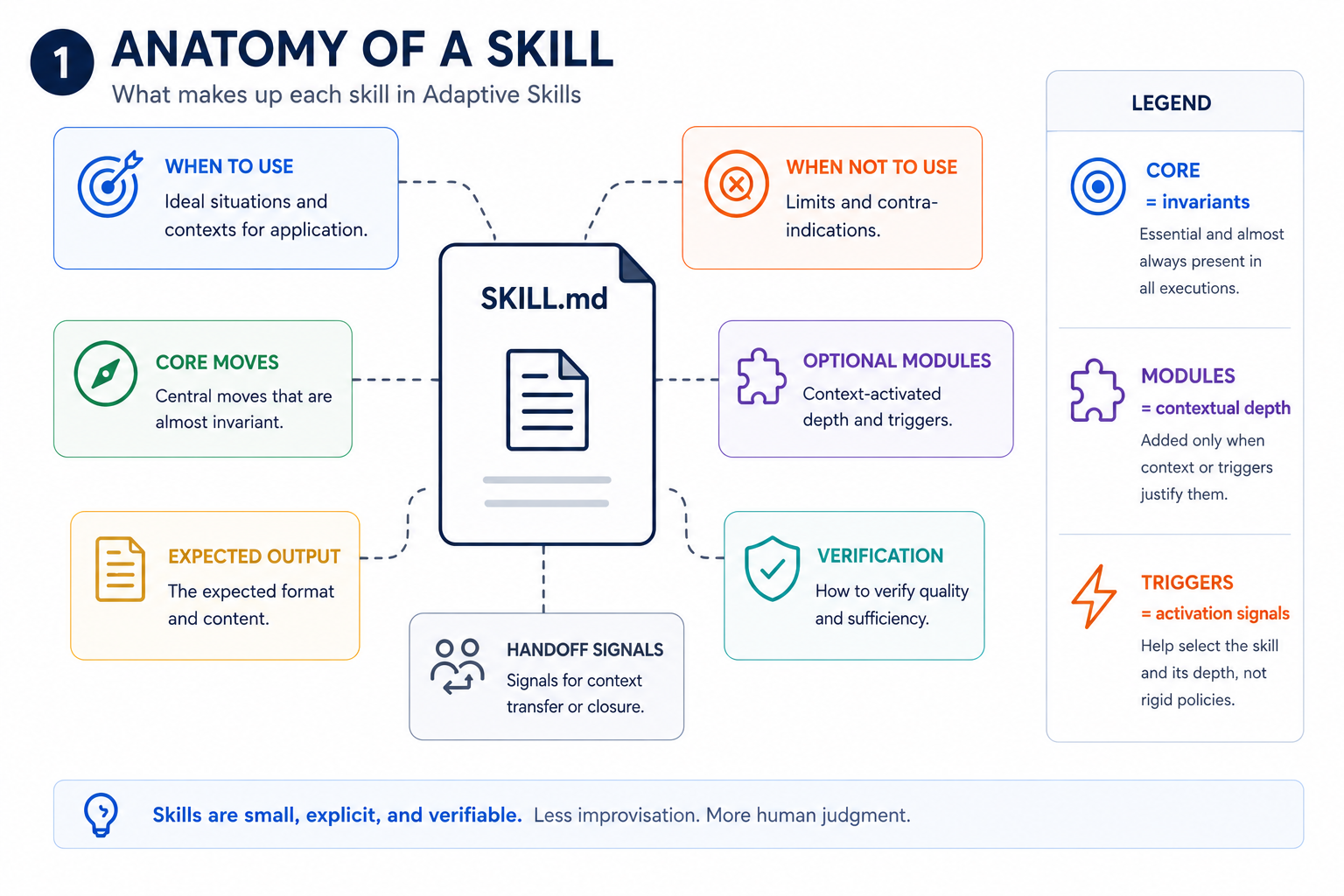
Anatomy of a Skill — the elements that define a reusable skill in Adaptive Skills.
Adaptive Skills uses a middle path:
- Core Moves for invariants
- Optional Modules for context-specific depth
- Activation Triggers for lightweight adaptiveness
Core Moves
Core Moves are the few actions that should almost always happen.
Rules:
- 3 to 5 moves
- durable over time
- easy to scan quickly
- not a full procedure tree
Optional Modules
Modules are contextual blocks.
Examples:
- risk review
- stakeholder alignment
- coverage gap analysis
- accessibility lens
Modules do not turn on by default.
Activation Triggers
Triggers are natural-language cues such as:
- if the change is high-risk
- if the work crosses multiple functions
- if an existing interface already exists
- if another system consumes the contract
- if the plan has meaningful cost of failure and can still change
They are not a mini policy engine.
Triggers help select both the skill and its depth.
For example, a reversible plan may not need premortem; a consequential plan with hidden assumptions, missing rollback, or human decision gates probably does.
Sidecars
A skill folder may include:
templates/checklists/examples/references/changelog.md
Only add them when they reduce cognitive load or improve reuse.
What not to do
- do not make the core a giant checklist
- do not create modules for one-off edge cases
- do not create empty sidecar folders
- do not turn a skill into a mini framework
- do not select skills just because they are available
Selection discipline
A skill should be selected because it improves the task, not because the catalog needs to be exercised.
Use this order:
- Identify the dominant need in the task.
- Choose the smallest skill that fits that need.
- Use
When NOT to Useto reject weak fits. - Activate optional modules only when the trigger is present.
- Verify the output using the skill’s verification section.
See docs/how-to-use-a-skill.md for a practical usage guide.
Catalog growth is governed by the Lean Skill Doctrine and Skill Catalog Governance. A new skill, module, merge, split or deprecation should pass the Skill Quality Gate before canon changes.
Governed evolution
Skills are living assets, but not every observation should change the library.
The evolution layer is designed to:
- capture real usage evidence
- distinguish local residue from reusable skill friction
- protect the most conceptually sensitive surfaces
- allow small proposals before structural edits
Valid outcomes include reinforced, no-change, and proposal-oriented results such as new-module-candidate.
Protected surfaces
In v1.1, the most sensitive surfaces stay protected from proposal-driven writeback:
nameanddescriptionWhen to Use/When NOT to UseCore Moves- skill category and domain boundaries
- merge or split decisions for skills
That keeps the library coherent while still allowing safer refinements in triggers, modules, verification, and sidecars.