Crisis Monitor Case Study
Reference documentation for Crisis Monitor Case Study in Adaptive Skills.
Why this case matters
The first real consumer test of Adaptive Skills happened in Crisis Monitor, using AletheIA as the macro layer and a small set of skills as the micro layer.
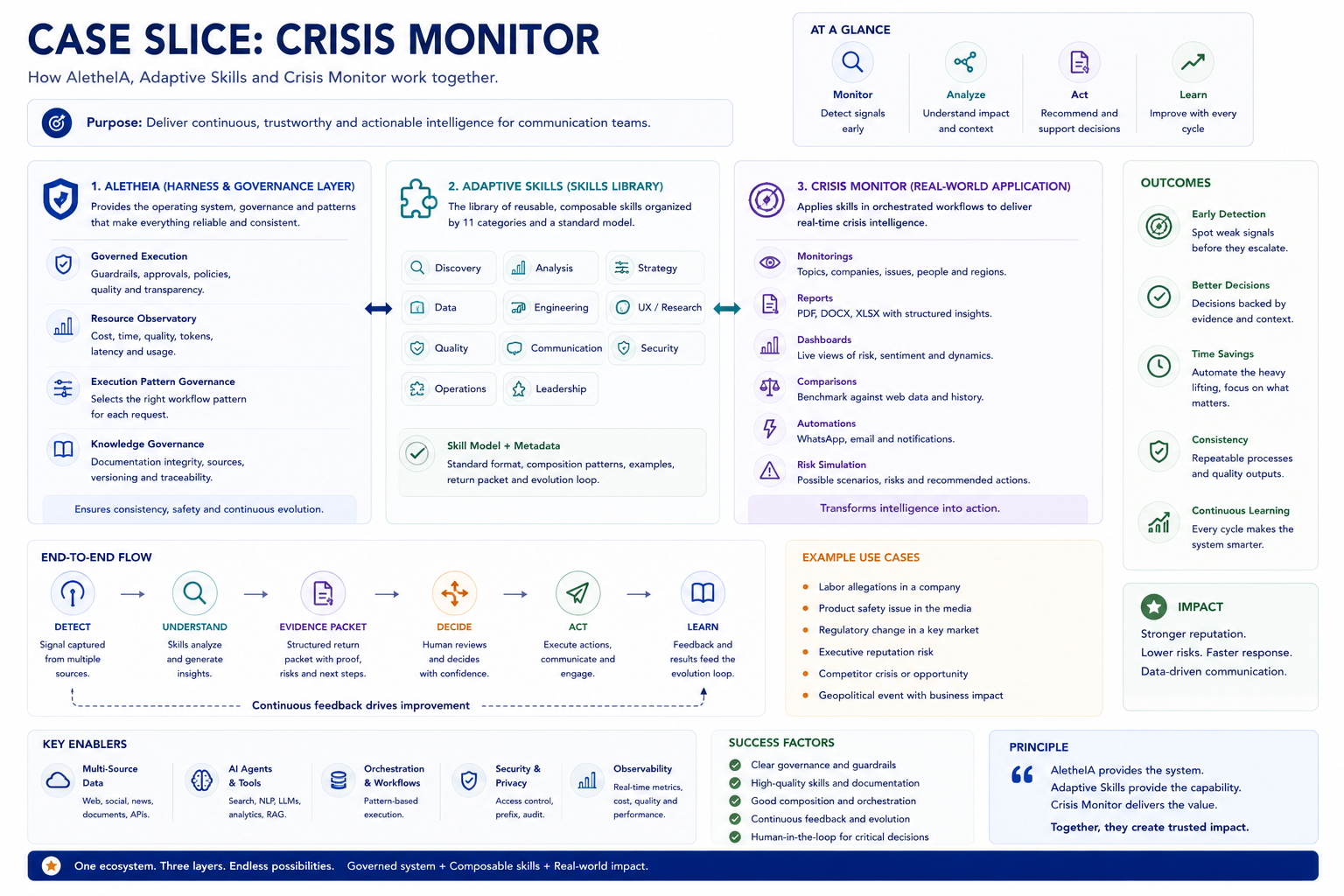
Case Slice: Crisis Monitor — supplementary illustration for the documented consumer case. The case narrative and evidence remain authoritative.
This matters because it was not a synthetic demo. It was a bounded, real product lane with existing signals, approvals, follow-up explainability, and auditability.
Context
The test stayed inside one small lane:
- routing
- approval
- follow-up explainability
The goal was not to launch a new framework rollout. The goal was to verify whether the macro/micro split would stay legible in real work.
Macro versus micro in the field
AletheIA handled the macro layer
- framing the immediate task
- setting minimum proof expectations
- reading whether review or handoff was needed
- preserving continuity between rounds
Adaptive Skills handled the micro layer
- shrinking the slice to the smallest useful change
- making the execution shape more explicit
- keeping verification proportional
- activating optional skills only when a real trigger appeared
Crisis Monitor kept its local rules
- domain semantics
- rollout constraints
- ownership boundaries
- approval and audit contracts
This separation was one of the most important outcomes of the pilot.
Round 1
Bundle used
workflowfeature-planningtesting
What it proved
- the base bundle was sufficient in a real lane
- the micro layer added discipline without creating a second governance framework
- the same lane already used by AletheIA was the right place to start
Evidence shape
The proof stayed intentionally small:
- smoke validation
- authenticated functional flow
- consistency between proposal card, audit trail, and follow-up explainability
Round 2
Additional skill activated
ux-writing
Why it activated
A real textual clarity problem appeared in the audit surface:
Justificativa humana do approval
That label mixed Portuguese and English in a place that needed fast operational reading. The round changed it to:
Justificativa humana da aprovação
What it proved
- optional skills work better when activated by real triggers, not by default enthusiasm
ux-writingwas useful as a precise micro adjustment, not as a broad copy rewrite- the same existing smoke remained enough as proportional proof
What the pilot proved overall
After two small rounds, the case study supports these conclusions:
- Macro/micro separation is usable in real work
- The base bundle is enough for an initial consumer pilot
- Optional skills should enter by trigger, not by default
- A small, auditable lane is a better first proving ground than a broad rollout
What the pilot did not prove
The case does not prove that:
- every lane in the product should adopt the library immediately
- every optional skill is ready to enter
- the library should become a product-wide dependency
- the same result will automatically generalize to more cross-functional or integration-heavy work
Expansion rule learned from the case
The most important operational rule from the Crisis Monitor pilot is:
expand only when a real trigger appears.
That means future rounds should be opened only if one of these is true:
- there is a new real textual or operational ambiguity
- another optional skill has a clear, verifiable trigger
- the current bundle hits a real limit that cannot be handled inside the same boundary
Recommended use of this case
Use this case when you need to explain:
- how Adaptive Skills works with AletheIA without depending on it
- what a small first consumer pilot should look like
- why skill activation by trigger is healthier than a large default bundle
- how to keep product-local rules out of the generic library
May 2026 boundary update
Crisis Monitor has completed the handoff from founder-led product execution to the development team. From this point, Adaptive Skills remains a reusable micro-layer and Crisis Monitor remains a field case, but Adaptive Skills evolution should not be driven through the Crisis Monitor backlog.
Operationally:
- Crisis Monitor keeps local product ownership, delivery priorities, and launch constraints.
- Adaptive Skills keeps reusable execution patterns, projections, and evolution mechanics.
- AletheIA remains the macro framework that can consume Adaptive Skills, but its framework decisions live outside the Crisis Monitor repository.
- Any future Crisis Monitor re-entry must happen through an explicit integration Issue, not through background framework work.