Skills catalog
Browse all published Adaptive Skills by category, trigger, and expected outcome.
Adaptive Skills currently publishes 38 portable skills. Use this page when you already know the kind of help you need. If the task is still unclear, start with Choose the right skill.
Each skill appears once in this catalog. Its skills/<name>/SKILL.md file remains the canonical instruction source.
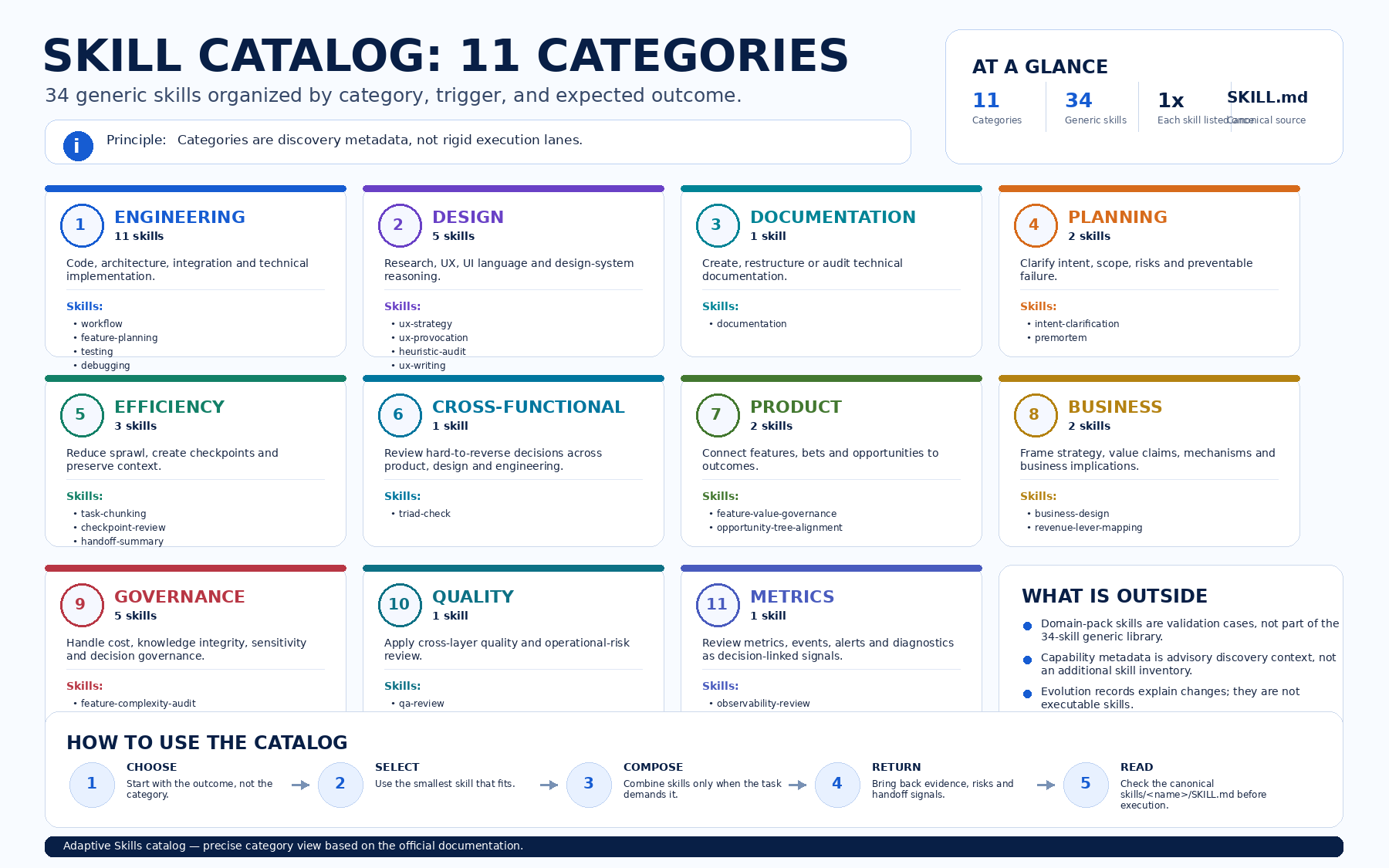
Skill Catalog: 11 Categories — 38 portable skills organized by category, trigger, and expected outcome.
Engineering
| Skill | Use it when | Expected outcome |
|---|---|---|
workflow |
Starting non-trivial work or returning from a handoff | Explicit scope, proof, and next step |
feature-planning |
Turning a feature request into staged delivery | Small, testable delivery plan |
testing |
Choosing proof before closing meaningful work | Risk-appropriate validation strategy |
debugging |
Investigating a reproducible failure | Isolated cause, fix, and recurrence guard |
api-design |
Defining a contract between components | Clear inputs, outputs, errors, and compatibility |
refactoring |
Improving structure without changing behavior | Safer, clearer structure with preserved behavior |
lean-implementation |
Implementing a confirmed bounded plan | Smallest safe change with evidence |
architecture-review |
Reviewing a consequential structural decision | Explicit alternatives, trade-offs, and recommendation |
code-style |
Improving consistency and readability | Applied rules without style dogma |
communication |
Explaining a change, failure, option, or handoff | Audience-appropriate, evidence-backed message |
domain-language-alignment |
Product, domain, docs, and code use different terms | Shared vocabulary before implementation |
Design
| Skill | Use it when | Expected outcome |
|---|---|---|
ux-strategy |
The interaction direction is still open | Compared directions and a reasoned position |
ux-provocation |
A dominant UX hypothesis needs pressure testing | Exposed assumptions and stronger alternatives |
heuristic-audit |
An existing interface has usability risks | Prioritized failures and defensible fixes |
ux-writing |
Product language is unclear or unsafe | Clear, actionable interface language |
design-system-intelligence |
Reviewing an artifact against declared design-system sources | Source-backed conformance and exception evidence |
experience-design |
A broad experience request needs selective composition | A bounded path through design building blocks |
Documentation
| Skill | Use it when | Expected outcome |
|---|---|---|
documentation |
Creating, restructuring, or auditing onboarding, manuals, guides, and technical documentation | Self-service reader journeys, source-backed content, controlled procedural clarity, and validated recovery paths |
Planning
| Skill | Use it when | Expected outcome |
|---|---|---|
intent-clarification |
Outcome, success, or constraints are ambiguous | Human-owned intent clarified before planning |
premortem |
A consequential plan could fail in costly ways | Failure causes, warning signals, and prevention |
Efficiency
| Skill | Use it when | Expected outcome |
|---|---|---|
task-chunking |
Work is oversized or likely to sprawl | Reviewable slices with stop conditions |
checkpoint-review |
A long task needs a continue-or-stop decision | Deliberate checkpoint and next-round decision |
handoff-summary |
Work is crossing a person, agent, or session boundary | Verified context for the next operator |
work-continuity-efficiency |
A broad continuity need requires selective composition | A bounded path through continuity building blocks |
Cross-functional
| Skill | Use it when | Expected outcome |
|---|---|---|
triad-check |
A hard-to-reverse decision crosses product, design, and engineering | Three-perspective decision review |
Product
| Skill | Use it when | Expected outcome |
|---|---|---|
product-management |
A product request spans framing, evidence, method selection, outcomes, or handoffs | Bounded product decision path with explicit modules, uncertainty, verification, and human boundaries |
feature-value-governance |
Deciding whether a feature deserves investment | Auditable value and overreach judgment |
opportunity-tree-alignment |
Backlog bets lack clear outcome links | Outcome-to-opportunity-to-lever alignment |
Business
| Skill | Use it when | Expected outcome |
|---|---|---|
business-design |
Framing product or business strategy from mixed signals | Structured facts, hypotheses, and implications |
revenue-lever-mapping |
A value claim has no measurable mechanism | Primary lever, metric, proxy, and risks |
Governance
| Skill | Use it when | Expected outcome |
|---|---|---|
feature-complexity-audit |
Permanent feature cost may change a build decision | Complexity scorecard and reduction recommendation |
sunset-decision |
An existing feature may no longer justify its cost | Keep, limit, refactor, deprecate, or remove decision |
knowledge-source-evaluation |
A document may become governed knowledge | Source maturity and registration decision |
knowledge-conflict-resolution |
Decision-relevant sources disagree | Precedence-based resolution or escalation |
restricted-context-check |
Sensitive or untrusted knowledge may enter task context | Leakage, injection, permission, and contamination check |
knowledge-governance |
A broad source-governance decision needs selective composition | A bounded path through governance building blocks |
Quality
| Skill | Use it when | Expected outcome |
|---|---|---|
qa-review |
A change needs a cross-layer quality gate | Consistency and operational-risk review |
Metrics
| Skill | Use it when | Expected outcome |
|---|---|---|
observability-review |
Metrics, events, alerts, or diagnostics need review | Decision-linked observable signals |
What is outside this catalog
- Domain-pack skills are validation cases and are not part of the 35-skill portable library.
- Capability metadata is an advisory discovery layer, not an additional skill inventory.
- Evolution records describe how skills improve; they are not executable skills.
Next steps
- Choose the right skill when several options seem plausible.
- Browse the complete skill reference for canonical public profiles of all 38 portable skills.
- Use a skill for invocation and evidence-return guidance.
- Try workflow recipes when the task needs more than one skill.
- Read the canonical
skills/<name>/SKILL.mdin your installed copy before execution.