Execution Pattern Governance
What this is
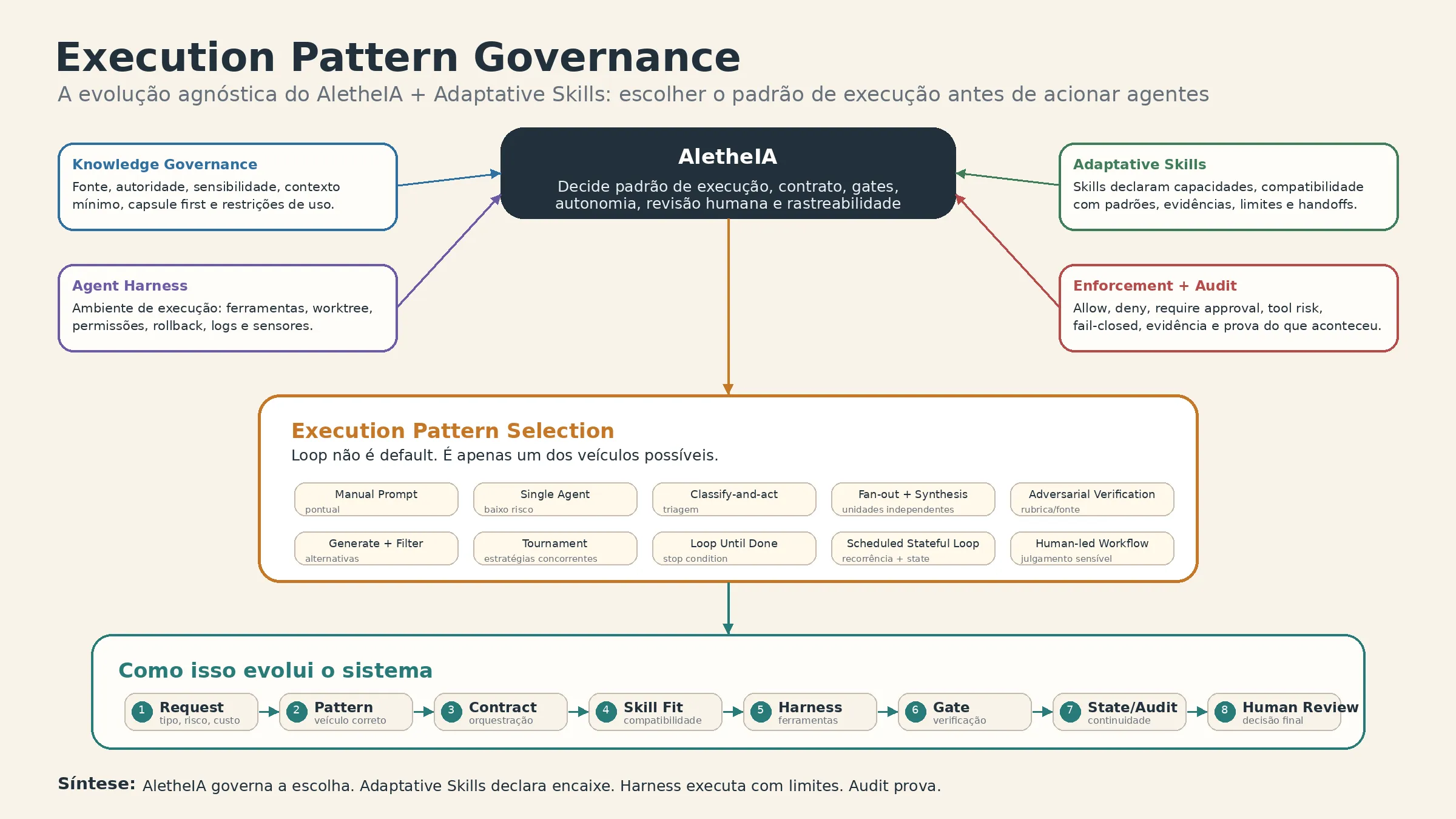
Execution Pattern Governance is the layer where AletheIA decides which shape of execution a task deserves before anything runs. AletheIA must not decide only which agent or skill to use: it must decide which execution pattern is proportional to the work type, the risk, the cost, the context, and the verification available.
It is a selection discipline, not a runtime, scheduler, orchestrator, or policy engine. It is docs-first and provider-agnostic: external references may inspire it, but the internal language stays vendor-neutral.
Where it sits
Pattern selection sits upstream of the per-task envelope: first AletheIA picks the topology of execution, then the task declares its Agent Harness Contract (AHC, ADR-013) and the rest of the chain applies.
User request
  ↓
AletheIA Task Assessment
  ↓
Execution Pattern Selection
  ↓
Orchestration Contract
  ↓
Adaptative Skills
  ↓
Agent Harness
  ↓
Policy / Enforcement Gates
  ↓
Objective Verification + Loop State + Audit
  ↓
Human Review / Final Decision
Responsibilities per layer
| Layer | Responsibility |
|---|---|
| AletheIA | Assesses task type, risk, uncertainty, recurrence, and verifiability; selects the execution pattern; defines the orchestration contract; defines gates, autonomy, and human review; records the decision |
| Adaptative Skills | Declares reusable capabilities; declares compatibility with execution patterns; declares the evidence each pattern requires; declares incompatibilities, escalation triggers, and handoff |
| Knowledge Governance Layer | Defines authorized sources, retrieval mode, precedence, and restrictions; prevents misuse of context in state, logs, and outputs |
| Agent Harness | Controls tools, worktree, permissions, sandbox, commands, logs, and rollback |
| Enforcement | Applies allow, deny, require approval, transform, or log only (the existing AHGE verdict vocabulary — reused, not redefined) |
| Audit / Observability | Records selected pattern, skill used, tool used, gate, evidence, cost, state, and decision |
Three axes, not one
Pattern selection introduces a third axis. The three are orthogonal and must not be conflated:
| Axis | Question it answers | Authority |
|---|---|---|
| Execution pattern | which shape — the topology of execution (single agent? fan-out? loop? tournament?) | this layer |
| Execution mode | how deep — how deep a capability runs (basic / extended / high-risk / multi-agent) | the Adaptative Skills repo (docs/execution-modes.md) |
| Autonomy level | how much authority — observe / advise / act_with_approval / autonomous_within_bounds |
autonomy-levels.md, carried by the AHC |
Every document in this layer that mentions patterns must keep this distinction. Choosing
fan_out_and_synthesize (topology) says nothing about how deep each unit runs (mode) or what each
unit is allowed to do (autonomy) — those are declared on their own axes.
Principles
- Agnosticism. External references may inspire, but internal language remains vendor-neutral.
- Proportionality. The execution pattern must be proportional to risk, cost, uncertainty, and the verification available.
- Verification before autonomy. Without an objective gate, there is no autonomous loop — only an assisted workflow or human judgment.
- Orchestration is a governable artifact. If there is routing, scoring, filtering, rerun, or comparison logic, it must be documented, reviewable, and auditable.
- Skills do not execute policy. Adaptative Skills declares compatibility, evidence, and limits; harness and enforcement apply the limits.
Related
- ADR-015 — the decision record for this layer
- Execution Pattern Library — the ten patterns and the selection rules
- Execution Vehicle Selection — vehicle vs. pattern, proportionality
- Comprehension Debt — the cost of generating more than anyone reads
- Agent Harness Contract — the per-task envelope downstream of pattern selection
- ADR-013 — the AHC reconciliation decision this layer composes with